
The Grand Egyptian Museum holds in trust for Egypt and the World a chronological statement for the ancient history of Egypt over the past 7000 years. Neighboring a timeless wonder, the Giza Pyramids, the new museum is to pay homage to eternal Ancient Egyptian monuments, treasures, and history hosting over 100,000 artifacts, about 3500 of which belong to the famous King Tutankhamen.
The design for the Grand Egyptian Museum was reached as a result of an international architectural competition initiated by the Ministry of Culture on January 7th, 2002. The competition was under the patronage of the UNESCO and supervised by the UIA. The museum complex aims to furnish all its visitors with a uniquely enjoyable, educational, and cultural experience.
The Grand Egyptian Museum will allow Egypt to become a major worldwide hub for Pharonic history and a must-visit place for Egyptologists. The museum aims at taking grasp of the diversity of Egypt’s heritage of monuments and arts needed to be shown in one place in one location to maintain and preserve this huge legacy.
The site chosen for the GEM is only 2km from the legendary Pyramids. Nested between the ancient Great Pyramids and the modern city of Cairo, at the junction between dry desert and the fertile floodplain, the Grand Museum is a portal to the past. The Giza plateau Memphis and its Necropolis nominated by UNESCO among the world Cultural Heritage Sites, contains irreplaceable monuments from across time.The museum complex will be built on a plot of land approximately 117 feddans, about 480,000 square meters.
With its unique position on the cusp between the past and the present, the Grand Egyptian Museum will lie at the repository for ancient artifacts that creates an interactive experience for the visitor; it will build a bridge between the past and the future.
Museum Master plan
GEM Landscape Plan
The functional areas and spatial sectors for GEM have been identified with reference to the various activities corresponding to the requirements of users and staff, and to fulfill the objectives of the project. The total area of the development (indoor – outdoor) is estimated to cover 480,000 square meters.
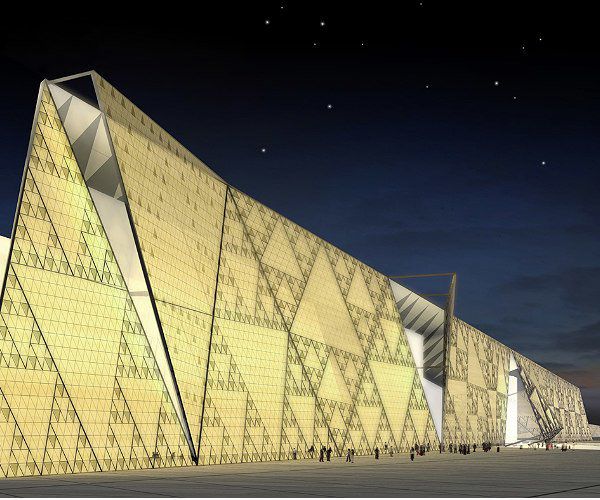
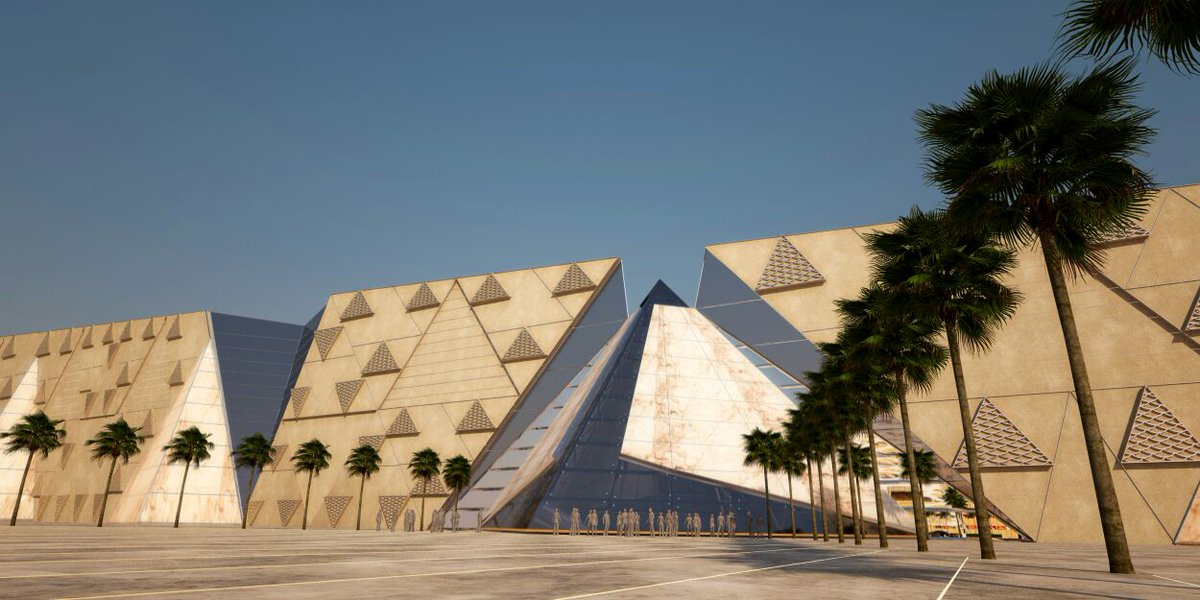
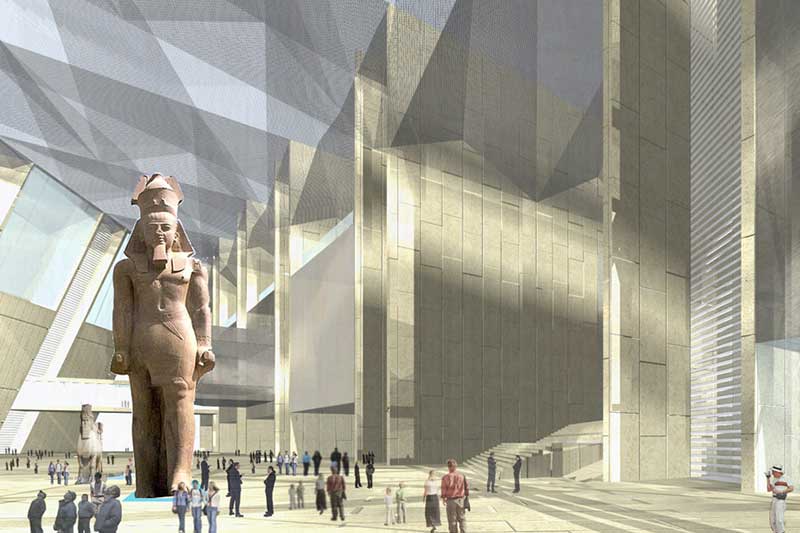
The Grand Egyptian Museum is a complex of buildings and landscape with one identity. The Master plan geometry structures the site at all scales from site plan to exhibition show cases, such that navigation within the complex is straightforward. The Landscape displays a number of thematic parks cafes and restaurants that offer entertainment and enjoyable resting places. This concept extends beyond site boundaries as the main building is structured by the sight line from the site to the pyramids. The main building comprises various exhibition spaces, library, mediatheque, education centre, conference centre and retail but is represented externally by one coherent surface-the translucent Serpinski Wall. On approach to the site from Cairo, the Serpinski Wall captures visitors’ attention and will be appreciated with reference to the pyramids. This wall is the iconographic identity for the entire complex.
The GEM is designed in such a manner to create a world class building capable of demonstrating the progress, evolution and development of the Egyptian Civilization. The technological infrastructure of the complex allows for the creation of modern archives and a library capable of facilitating the management, maintenance, and preservation of the collection, as well as research-related activities.
Please sign in to see contact details.


Leave a Reply